
+91 98941 76136
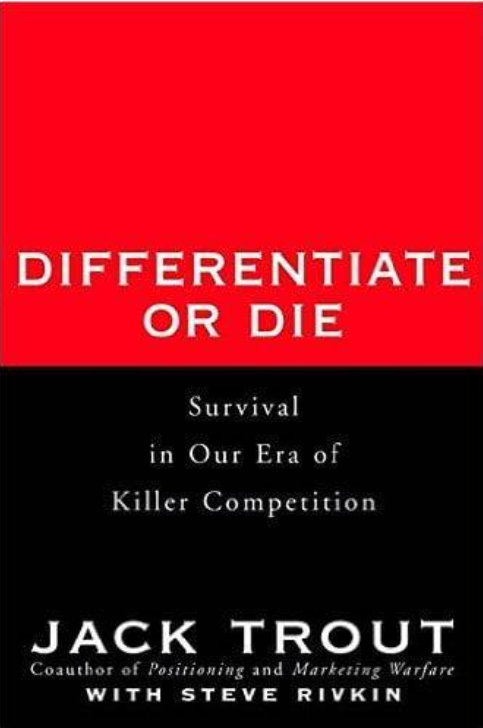
Differentiate or Die Book Review In the fast-paced, competitive world of business, one principle consistently proves true: if you don’t stand out, you fade away. Jack Trout’s book Differentiate or Die is a timeless classic in marketing literature that drives home this idea. First published in 2000 and updated in later editions, the book offers a practical roadmap for businesses, entrepreneurs, and marketers to build unique market positions that customers cannot ignore.
The book is not just theory — it’s filled with real-world examples from brands across industries. Trout explains why differentiation is not optional, but the very foundation of survival and growth in crowded markets.
The central thesis of Differentiate or Die is simple yet profound: a product, service, or company must differentiate itself in the minds of customers — or risk becoming irrelevant.
Today, consumers face a flood of choices in every industry — from toothpaste to tech services. With limited attention spans, people often choose brands they remember most clearly, not necessarily the ones with the best features. Trout argues that businesses need to carve out a clear, simple, and meaningful identity that sets them apart.
Customers are bombarded daily with ads and promotions. To break through this clutter, a business must send a sharp, clear, and consistent message.
Lesson: Simplicity wins.
What matters is not what you think about your product, but what customers perceive it to be.
Lesson: Build your brand in the mind of your customer.
When businesses fail to differentiate, they fall into commoditization where price becomes the only deciding factor.
Lesson: Create value beyond price.
Being the First, Product Superiority, Leadership, Heritage, Specialization, Preference.
Lesson: Pick one differentiation strategy and own it.
Trout cautions against the vague claim of being ‘better.’
Lesson: Narrow focus builds strong brands.
Emotional connections often create stronger loyalty.
Lesson: Balance rational benefits with emotional storytelling.
For entrepreneurs, consultants, and business coaches, Differentiate or Die offers highly actionable guidance: